


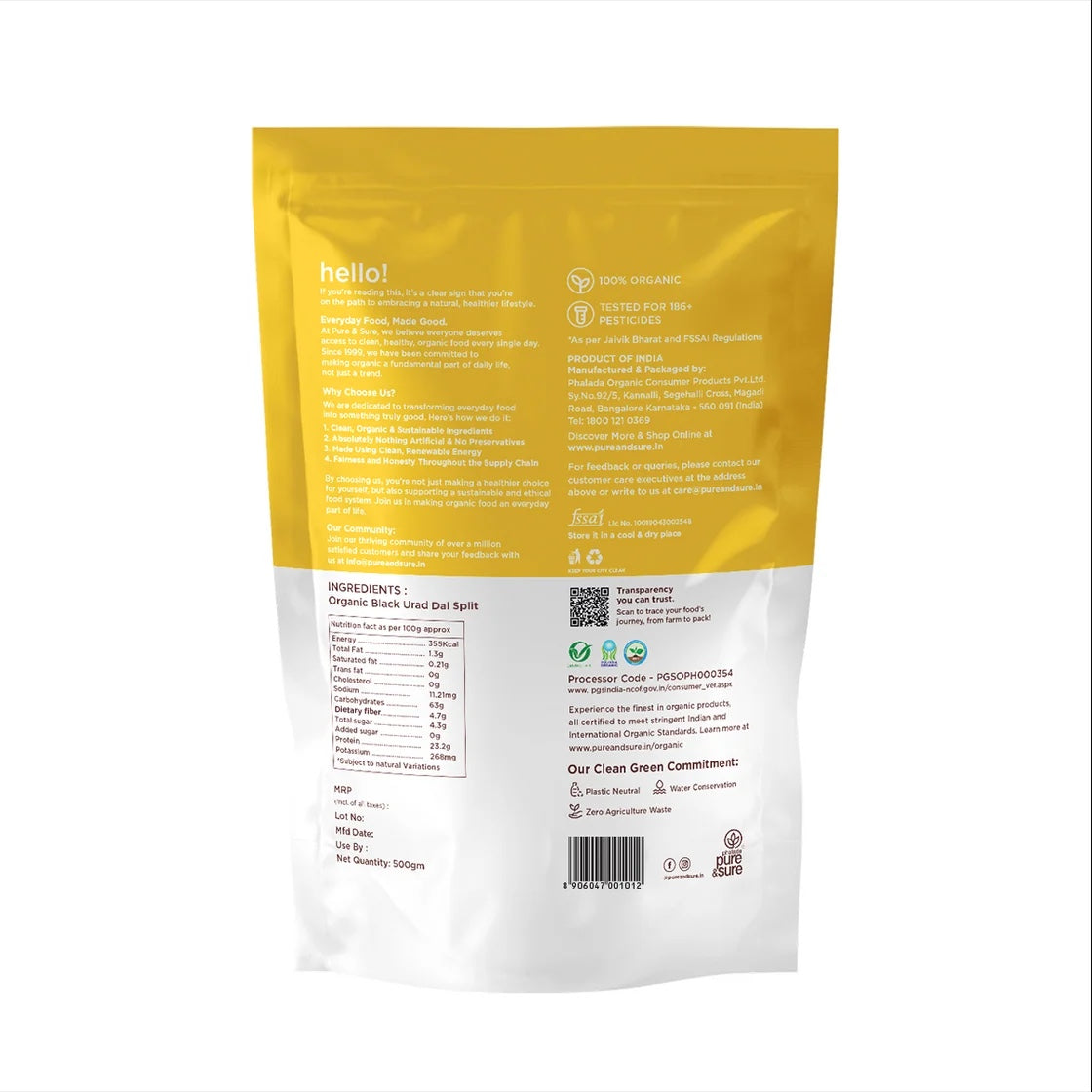
Why we picked it
-
 The skins are left on each split grain, which is what separates chilka from fully dehusked urad.
-
 The energy figure on the panel reconciles with the macros, which is not always true of pulse packs.
-
 23.2 g of protein per 100 g.


What to look for in Black Urad Split?
What to look for in Black Urad Split?
- 01Polished pulses are buffed with water, oil, talc or soapstone purely for shelf appeal. It strips the outer layer and can leave residue behind. Unpolished dal looks duller, and that is the point.
- 02Uniform colour and high gloss are warning signs in dal, not quality markers.
- 03Metanil yellow is a banned dye used to brighten yellow dals. Rub a few grains between wet palms: dye lifts onto skin and polish leaves a slick. Neither should happen.
- 04Organic certification covers how it was farmed, not whether it was adulterated. They are two different tests.
What's inside
Black gram split in half with the skins left on, the form usually sold as chilka urad.
Each split grain keeps its black jacket, which holds the colour and stops the dal collapsing into paste.
The colour is the skin's own.
Pure & Sure Urad Chilka vs other urad chilkas
| What to compare | Purepicked | Regular black urad split |
|---|---|---|
| Ingredient list | Urad only | Also urad only; what differs is how the grain is treated, not what is added |
| Skins | Left on each split grain | Often part-dehusked to look neater |
| Nutrition panel | Energy reconciles with the macros | Frequently does not |
| Farming | Certified organic, PGS processor code on pack | Conventional, with no certification code to check |
Nutrition facts · per 100 g
- Energy
- 355 kcal
- Protein
- 23.2 g
- Carbohydrate
- 63 g
- Total sugars
- 4.3 g
- Added sugars
- 0 g
- Dietary fibre
- 4.7 g
- Total fat
- 1.3 g
- Saturated fat
- 0.21 g
- Trans fat
- 0 g
- Cholesterol
- 0 mg
- Salt
- 0.03 g
How to use it
- Rinse two or three times until the water runs clear
- Soak two to four hours; shorter than whole urad but not skippable
- Pressure-cook fifteen to twenty minutes after soaking, then simmer to thicken
- Finish with a tarka of ghee, cumin, ginger and garlic
Is it for you?
Good for
Tarka dal, kaali dal and everyday gravies
Quicker dal makhani-style dishes
High-protein vegetarian and vegan cooking
Avoid if
Anyone buying for idli or dosa batter — chilka urad will not grind to the right smooth paste
Cooks who want a pale, light dal; the skins keep it dark and give it body
Anyone who wants zero soaking — this still needs two to four hours
Product details
- Sold by
- Purepicked
- Brand
- Pure & Sure
- Net quantity
- 500 g
- Type
- Split Dal (Dhuli)
Also on the label
Questions people ask
How is chilka different from whole black urad?
Each grain is split but keeps its black skin. It cooks faster and breaks down further than the whole bean, giving a creamy dal without a full night's simmer, while staying dark.
Do I need to soak it?
Yes, two to four hours. That's shorter than whole urad, but not skippable. Rinse two or three times first.
How do I cook it?
Pressure-cook 15 to 20 minutes after soaking, then simmer to thicken. Finish with a tarka of ghee, cumin, ginger and garlic.
Can I use it for idli or dosa batter?
No. Chilka urad won't grind to the right smooth paste. Use dehusked white urad for batter.
Is it lab tested?
No product-level lab report is attached to this listing. The Clean verdict rests on a single-ingredient, certified organic pack.
Still unsure? Ask us on WhatsApp