


Why We Like It
- This isn't just marketed as unrefined — the lab report backs it up.
- Single ingredient, no additives, fillers or preservatives, and the lab confirms it.
- Lab-confirmed absence of eight synthetic colours, which is not a test this category usually runs.
- Not iodised, which is worth knowing if this is your household's main salt.
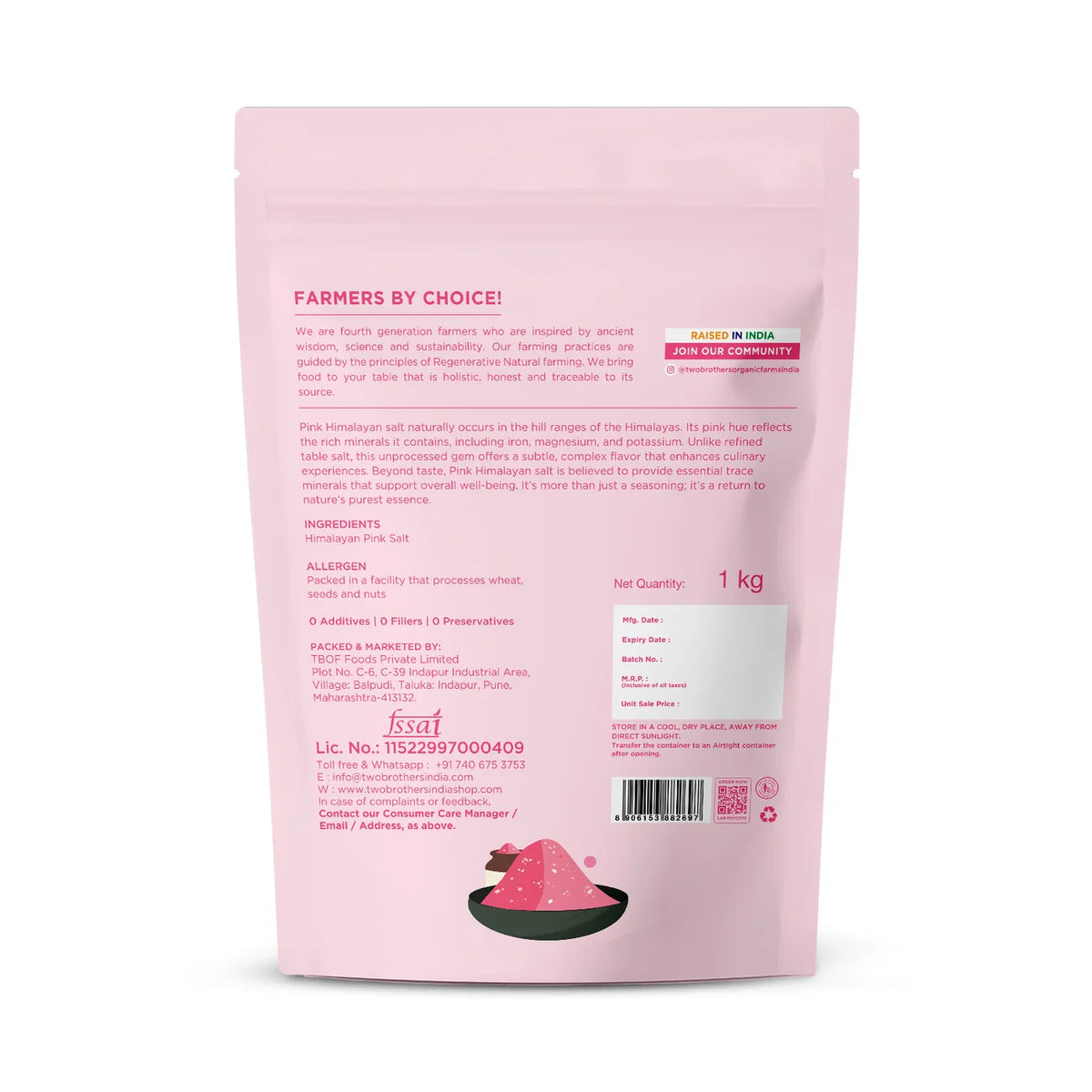
Ingredients
Himalayan Rock Salt
Single ingredient, unrefined, hand-minedNot iodised.
Two Brothers Pink Himalayan Rock Salt versus other table salts
| What to compare | Purepicked | Regular table salt |
|---|---|---|
| Ingredient list | Rock salt only | Often carries INS 535, 536 or 554 as free-flow agents |
| Processing | Unrefined, hand-mined | Refined, and usually iodised |
| Trace minerals | Calcium, magnesium and iron present, lab-tested | Largely stripped during refining |
| Colour | Lab-confirmed absence of 8 synthetic colours | Not routinely tested |
Is It For You?
Good for
Those wanting an unrefined rock salt as a rotation or finishing salt alongside iodised table salt
Avoid if
Those relying on salt as their primary dietary iodine source (rock salt is not iodised)
How to use
General seasoning and cooking
Finishing salt for dishes
Not recommended as sole salt source if relying on iodised salt for dietary iodine
What to look for in Salt?
Anti-caking agents keep salt pouring freely. Salt without them clumps in humidity, which is the honest trade.
Rock salt colour comes from trace minerals and varies naturally. Suspiciously uniform pink can mean added colour.
Unrefined rock salt is not iodised. If iodine matters in your household, check the pack rather than assuming.
'Sendha namak' and 'Himalayan pink salt' are names for rock salt, not grades of quality.
Sodium content is what matters nutritionally, and it is broadly the same across rock and table salt. Mineral claims are marketing.