


Why We Like It
- This pickle skips oil entirely and lets old-fashioned lacto-fermentation do the preserving, on native-variety lemons.
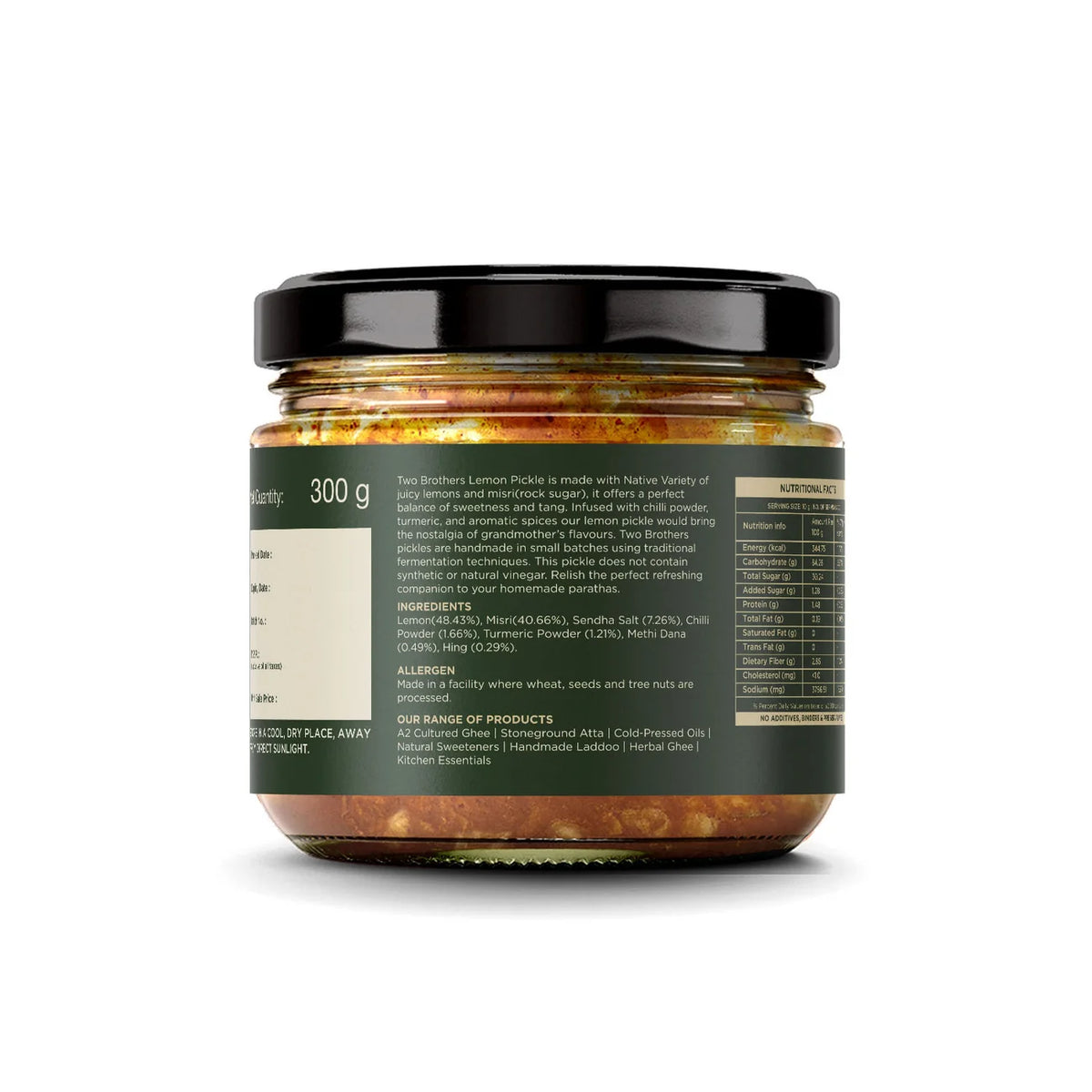
- Every ingredient carries a percentage — lemon, misri, rock salt and four spices, nothing else.
- The lab report comes back clean across microbiology, heavy metals and a 30+ analyte pesticide panel.
- Oil-free means 0.19 g of fat per 100 g, where a traditional achaar is mostly oil.
Ingredients
Lemon (48.43%)
Primary ingredient, whole fruitNative-variety lemons, fermented with salt and misri over several weeks; no oil, no heat and no vinegar.
Misri, rock sugar (40.66%)
NoteUnrefined sugar that drives the ferment and balances the sourness; at over 40% it makes this a genuinely sweet pickle.
Sendha Salt (7.26%)
NoteRock salt, the preserving agent, and the reason sodium sits at 3786.51 mg per 100 g.
Chilli Powder (1.66%)
CleanFlavouring.
Turmeric Powder (1.21%)
CleanFlavouring.
Methi Dana (0.49%)
CleanFenugreek seed, traditional pickle spice.
Hing (0.29%)
CleanAsafoetida, traditional pickle spice.
Nutrition factsPer 100g
- Energy kcal
- 344.75 kcal
- Protein g
- 1.48 g
- Carbohydrate g
- 84.28 g
- Total sugars g
- 30.24 g
- Added sugars g
- 1.28 g
- Dietary fibre g
- 2.85 g
- Total fat g
- 0.19 g
- Saturated fat g
- 0 g
- Trans fat g
- 0 g
- Salt g
- 9.47 g
Two Brothers Lemon Pickle versus other lemon pickles
| What to compare | Purepicked | Regular commercial pickle |
|---|---|---|
| Oil content | Oil-free, 0.19 g fat per 100 g | Usually oil-based |
| Preservation method | Lacto-fermentation | Often vinegar plus chemical preservatives |
| Preservatives | None | Sodium benzoate and other preservatives are common |
| Lemon variety | Heirloom Kaagzi lemon | Variety rarely named |
Is It For You?
Good for
Everyday meal accompaniment with rice, roti or dal
Those wanting a probiotic, oil-free pickle
Mixed into yoghurt for a quick tangy dip
Pairing with upma or a ghee-toasted paratha
Avoid if
Anyone on a strict low-sodium diet — a 10 g serve carries about 379 mg of sodium
Anyone limiting sugar — misri is 40.66% of the jar
Those who prefer oil-based pickles for a longer shelf life
How to use
Serve as a table condiment with rice, roti, dal or parathas
Use a dry spoon each time to avoid introducing moisture into the jar, and store in a cool, dry place away from direct sunlight
What to look for in Pickle?
Traditional pickle is preserved by salt, oil and spice. Class II preservatives such as benzoates and sulphites mean the cure is doing less of the work.
Oil should sit above the pickle as a seal. A dry-looking jar spoils faster once opened.
Acetic acid and added colour are the usual shortcuts. Real pickle darkens as it ages rather than staying bright.
Check which oil is named. Cold-pressed mustard or sesame is traditional; unnamed 'edible oil' tells you nothing.