


Why we picked it
-
 It is simply one ingredient, no polish, no brightening.
-
 Toor is the dal most often stretched with khesari, so single-ingredient sourcing matters more here than in most pulses.
-
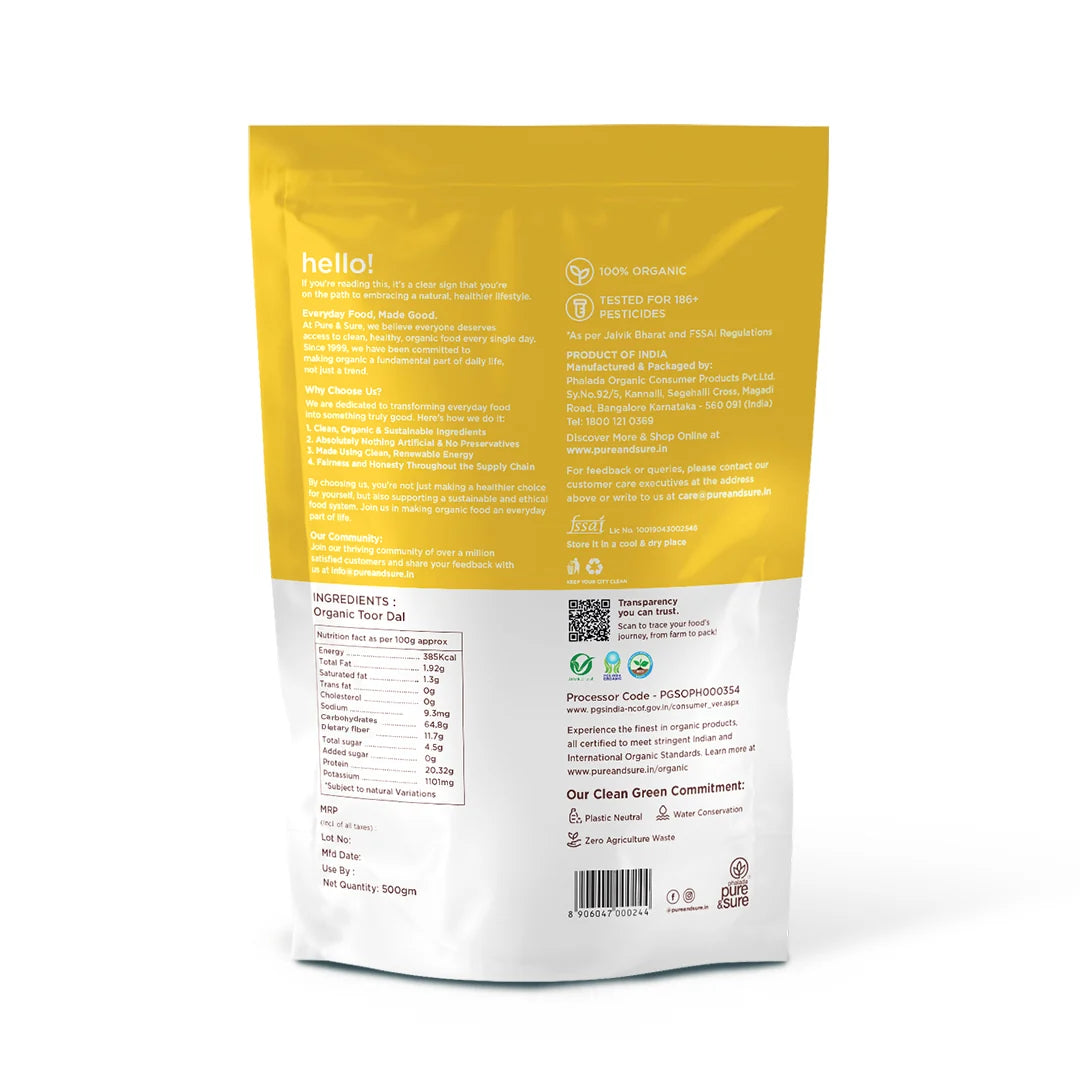
 1,101 mg of potassium per 100 g.


What to look for in Toor Dal?
What to look for in Toor Dal?
- 01Polished pulses are buffed with water, oil, talc or soapstone purely for shelf appeal. It strips the outer layer and can leave residue behind. Unpolished dal looks duller, and that is the point.
- 02Uniform colour and high gloss are warning signs in dal, not quality markers.
- 03Metanil yellow is a banned dye used to brighten yellow dals. Rub a few grains between wet palms: dye lifts onto skin and polish leaves a slick. Neither should happen.
- 04Organic certification covers how it was farmed, not whether it was adulterated. They are two different tests.
- 05Toor is the dal most often stretched with khesari (Lathyrus), which is prohibited, impossible to spot by eye, and the reason to buy from brands that test.
What's inside
Split pigeon peas with nothing added, coated or blended in.
Oil, water and soapstone polishing give older stock a fresh gloss.
Yellow dals are the standard target for metanil yellow, a banned dye used to brighten dull stock.
Toor is the dal most often stretched with khesari (Lathyrus sativus), which is prohibited. This is toor alone.
Dried pulses need none.
Pure & Sure Toor Dal vs other toor dals
| What to compare | Purepicked | Regular toor dal |
|---|---|---|
| Ingredient list | Toor dal only | Also toor only; what differs is how the grain is treated, not what is added |
| Polishing | Unpolished | Often oil- or water-polished, sometimes twice |
| Colour | Soft natural yellow | Metanil yellow is a documented dye adulterant |
| Farming | Certified organic, PGS processor code on pack | Conventional, with no certification code to check |
Nutrition facts · per 100 g
- Energy
- 385 kcal
- Protein
- 20.32 g
- Carbohydrate
- 64.8 g
- Total sugars
- 4.5 g
- Added sugars
- 0 g
- Dietary fibre
- 11.7 g
- Total fat
- 1.92 g
- Saturated fat
- 1.3 g
- Trans fat
- 0 g
- Cholesterol
- 0 mg
- Salt
- 0.02 g
How to use it
- Rinse three or four times until the water runs clear
- Soak twenty to thirty minutes; it is not essential but cuts the cooking time
- Pressure-cook one part dal to three parts water, roughly three or four whistles
- Finish with a tadka of ghee, mustard seeds, curry leaves and hing
Is it for you?
Good for
Sambar, rasam and everyday dal
Dal fry, dal tadka and South Indian cooking
High-protein vegetarian and vegan meals
Avoid if
Anyone who wants a dal ready in ten minutes — unpolished toor takes longer than the glossy kind
Cooks who expect a uniform bright yellow — undyed toor varies batch to batch
Low-potassium diets, where dals are usually restricted
Product details
- Sold by
- Purepicked
- Brand
- Pure & Sure
- Net quantity
- 500 g, 1 kg
- Type
- Split Dal (Dhuli)
Also on the label
Questions people ask
Why does it look duller than other toor dal?
It is unpolished and has no added colour, so it is matte, slightly uneven and a softer yellow that varies batch to batch.
How do I cook it?
Rinse three or four times, soak 20 to 30 minutes if you can, then pressure-cook one part dal to three parts water for about three or four whistles.
Why does it take longer than the glossy kind?
Unpolished toor takes a little longer to cook. The short soak helps cut the cooking time.
Who should avoid it?
Anyone on a low-potassium diet, where dals are usually restricted. It has 1,101 mg of potassium per 100 g.
Is it lab tested?
No product-level lab report is attached to this listing. The Clean verdict rests on a single-ingredient, unpolished, certified organic pack.
Still unsure? Ask us on WhatsApp