


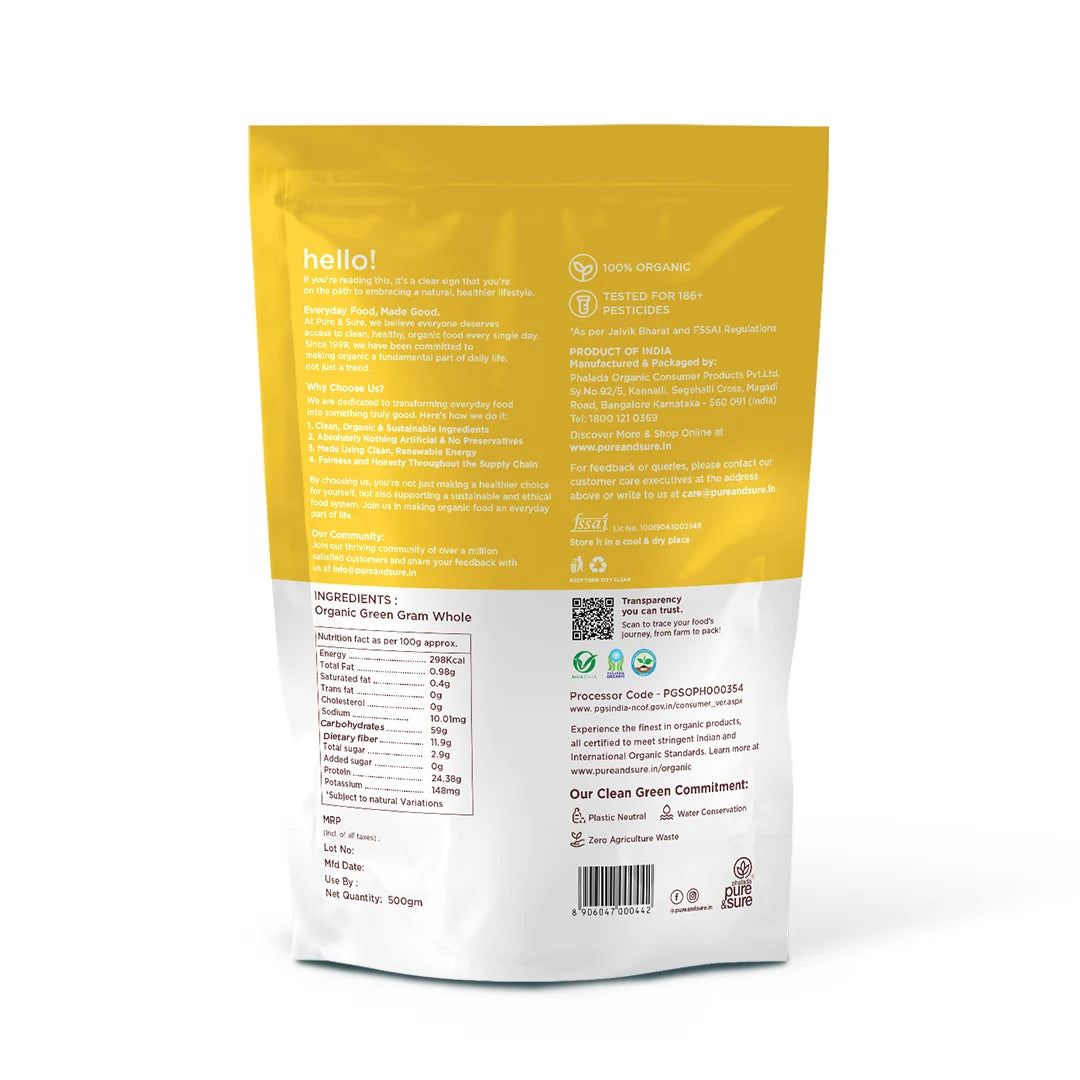
Why We Like It
- Single ingredient, and a kitchen staple held to the same no-additive standard as the rest of the range.
- Whole and skin-on, so it still sprouts — the test of moong that has not been over-processed.
- 24.4 g protein and 11.9 g fibre per 100 g.
Ingredients
Organic green gram whole (100%)
Single ingredientWhole moong beans with the skin on and nothing added.
No polish
Not usedPolishing with oil or water is used to give older stock a fresh shine.
Skin retained
The green skin is the fibre, and it is also what makes the bean able to sproutDehusked moong dal cannot.
No preservative or colour
Not usedDried pulses need neither.
Nutrition factsPer 100g
- Energy kcal
- 298 kcal
- Protein g
- 24.38 g
- Carbohydrate g
- 59 g
- Total sugars g
- 2.9 g
- Added sugars g
- 0 g
- Dietary fibre g
- 11.9 g
- Total fat g
- 0.98 g
- Saturated fat g
- 0.4 g
- Trans fat g
- 0 g
- Cholesterol mg
- 0 mg
- Salt g
- 0.03 g
Pure & Sure Sabut Moong versus other whole moongs
| What to compare | Purepicked | Regular green gram |
|---|---|---|
| Ingredient list | Green gram only | Also green gram only; what differs is how the grain is treated, not what is added |
| Polishing | Unpolished | Often polished for shine |
| Appearance | Matte, uneven green | Uniform and glossy |
| Sprouting | Whole and skin-on, so it sprouts | Depends on age and how it was treated |
| Farming | Certified organic, PGS processor code on pack | Conventional, with no certification code to check |
Is It For You?
Good for
Sprouting for salads, chaats and stir-fries
Whole moong dal, khichdi and pongal
High-protein diet
Avoid if
Anyone wanting a dal that cooks in ten minutes — skin-on whole moong needs soaking and time
Cooks who want a smooth yellow dal — the green skins stay visible and give a firmer, earthier result
Anyone who finds whole pulses hard to digest; the skins are the fibre and that is the trade-off
How to use
Soak six to eight hours before cooking; whole moong needs longer than the split dal
Pressure-cook fifteen to twenty minutes after soaking for a whole moong dal or khichdi
To sprout, soak eight hours, drain fully, then keep damp in a covered vessel for one to two days, rinsing twice a day
Rinse sprouts thoroughly before eating and keep them refrigerated
What to look for in Green Gram?
Polished pulses are buffed with water, oil, talc or soapstone purely for shelf appeal. It strips the outer layer and can leave residue behind. Unpolished dal looks duller, and that is the point.
Uniform colour and high gloss are warning signs in dal, not quality markers.
Metanil yellow is a banned dye used to brighten yellow dals. Rub a few grains between wet palms: dye lifts onto skin and polish leaves a slick. Neither should happen.
Organic certification covers how it was farmed, not whether it was adulterated. They are two different tests.
Whole skin-on moong should sprout within a couple of days. If it will not, it has been over-processed or is simply old.