


Why we picked it
-
 This one is matte and softly yellow, which is what unpolished and undyed looks like.
-
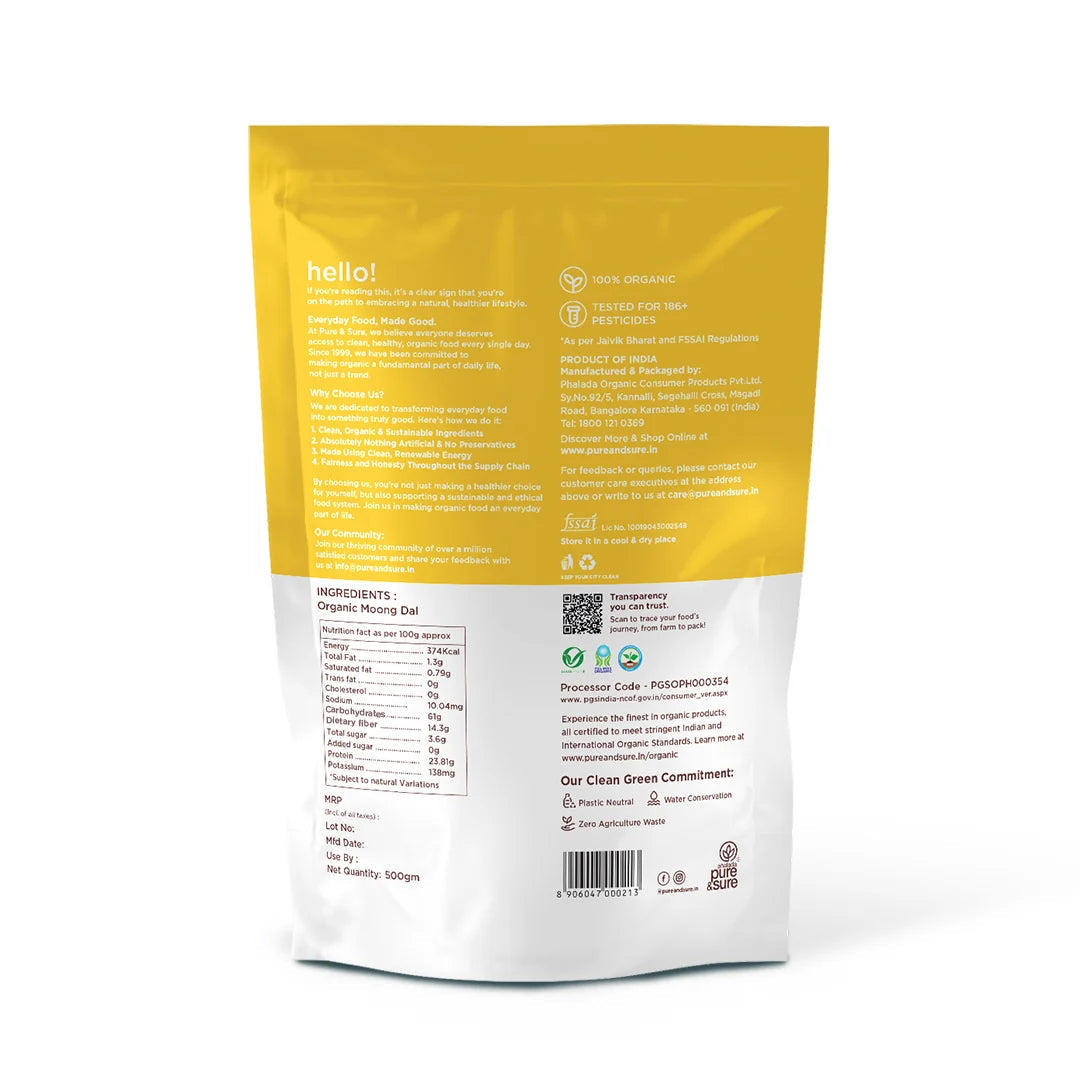
 Single ingredient, with nothing added, coated or blended in.
-
 14.3 g of fibre per 100 g.


What to look for in Moong Dal?
What to look for in Moong Dal?
- 01Polished pulses are buffed with water, oil, talc or soapstone purely for shelf appeal. It strips the outer layer and can leave residue behind. Unpolished dal looks duller, and that is the point.
- 02Uniform colour and high gloss are warning signs in dal, not quality markers.
- 03Metanil yellow is a banned dye used to brighten yellow dals. Rub a few grains between wet palms: dye lifts onto skin and polish leaves a slick. Neither should happen.
- 04Organic certification covers how it was farmed, not whether it was adulterated. They are two different tests.
What's inside
Split moong with nothing added, coated or blended in.
Oil, water and soapstone polishing are used to give older stock a fresh gloss.
Yellow dals are the usual target for metanil yellow, a banned dye used to brighten dull or aged stock.
Dried pulses need none.
Pure & Sure Moong Dhuli vs other moong dals
| What to compare | Purepicked | Regular moong dal |
|---|---|---|
| Ingredient list | Moong dal only | Also moong dal only; what differs is how the grain is treated, not what is added |
| Polishing | Unpolished | Often polished for shine |
| Colour | Soft natural yellow | Metanil yellow is a documented dye adulterant |
| Appearance | Matte, slightly uneven | Uniform and glossy |
| Farming | Certified organic, PGS processor code on pack | Conventional, with no certification code to check |
Nutrition facts · per 100 g
- Energy
- 374 kcal
- Protein
- 23.81 g
- Carbohydrate
- 61 g
- Total sugars
- 3.6 g
- Added sugars
- 0 g
- Dietary fibre
- 14.3 g
- Total fat
- 1.3 g
- Saturated fat
- 0.79 g
- Trans fat
- 0 g
- Cholesterol
- 0 mg
- Salt
- 0.03 g
How to use it
- Rinse two or three times until the water runs clear
- Cook one part dal to three parts water, roughly twenty minutes, or three whistles in a pressure cooker
- No soaking needed, though twenty minutes in water speeds it up
- Finish with a tadka of ghee, cumin and hing once the dal is soft
Is it for you?
Good for
Khichdi, everyday dal and light curries
Soups and one-pot meals
High-protein vegetarian and vegan meals
Avoid if
Anyone who wants a dal that holds its shape — moong dal collapses into a soft, smooth dal by nature
Cooks after a deep, heavy dal; this is the lightest of the everyday dals
Anyone expecting a bright uniform yellow — undyed moong dal is paler and varies by batch
Product details
- Sold by
- Purepicked
- Brand
- Pure & Sure
- Net quantity
- 500 g, 1 kg
- Type
- Split Dal (Dhuli)
Also on the label
Questions people ask
Do I need to soak it?
No. Rinse until the water runs clear and cook. Twenty minutes in water speeds it up if you have time.
How do I cook it?
Use one part dal to three parts water for about 20 minutes, or three whistles in a pressure cooker. Add a tadka of ghee, cumin and hing once it's soft.
Why is it paler than the moong dal I usually buy?
It is unpolished and undyed, so it looks matte and softly yellow and varies by batch. Bright, glossy yellow dal is often polished.
Will it hold its shape?
No. Moong dal collapses into a soft, smooth dal by nature. It is the lightest of the everyday dals.
Is it lab tested?
No product-level lab report is attached to this listing. The Clean verdict rests on a single-ingredient, unpolished, certified organic pack.
Still unsure? Ask us on WhatsApp