


Why we picked it
-
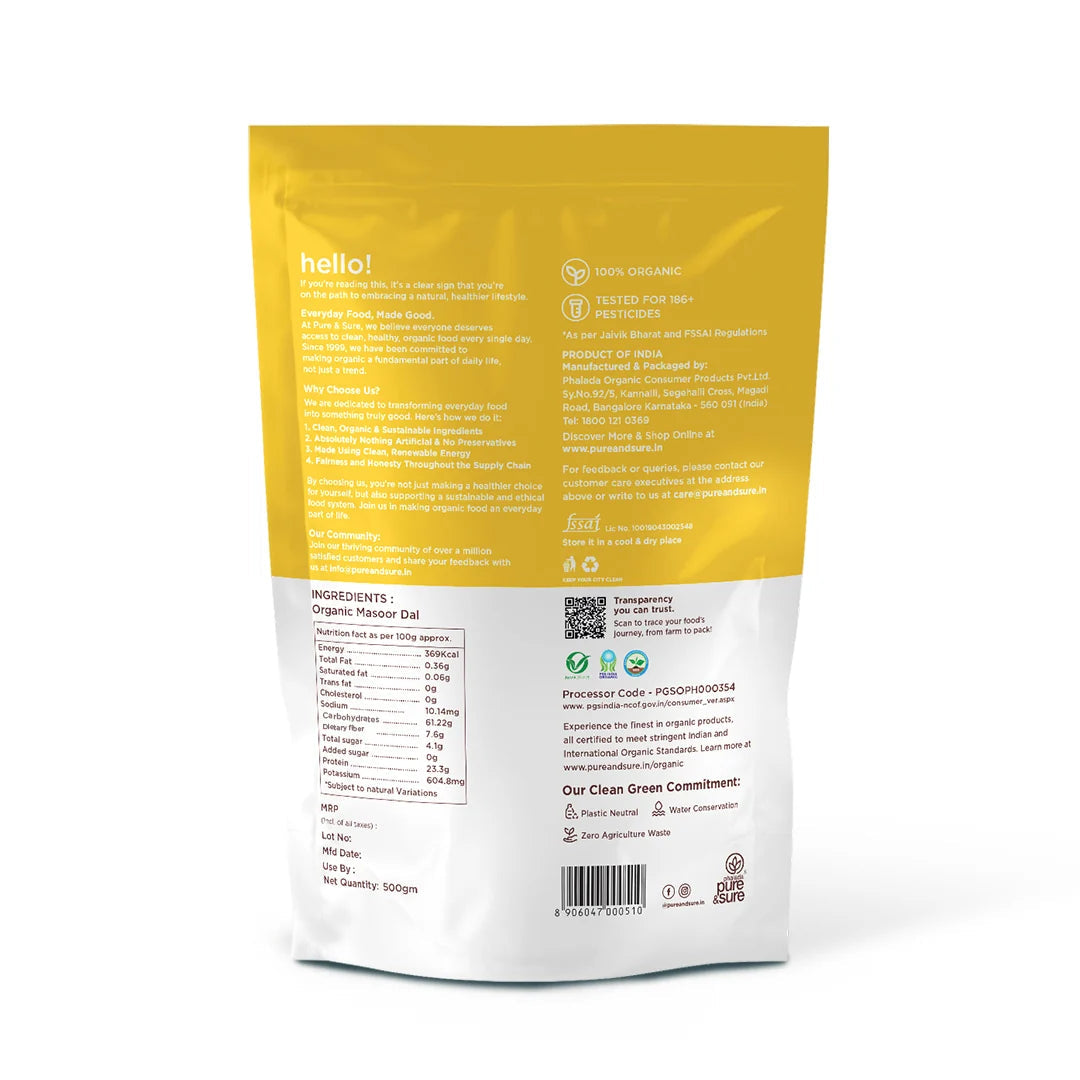
 One ingredient, a checkable organic code, and a protein figure that stands up.
-
 Natural salmon colour with a matte surface — uniform glossy orange usually means polishing or added colour.
-
 India Organic and Jaivik Bharat marks, with a PGS-India processor code printed on the pack.


What to look for in Masoor Dal?
What to look for in Masoor Dal?
- 01Polished pulses are buffed with water, oil, talc or soapstone purely for shelf appeal. It strips the outer layer and can leave residue behind. Unpolished dal looks duller, and that is the point.
- 02Uniform colour and high gloss are warning signs in dal, not quality markers.
- 03Metanil yellow is a banned dye used to brighten yellow dals. Rub a few grains between wet palms: dye lifts onto skin and polish leaves a slick. Neither should happen.
- 04Organic certification covers how it was farmed, not whether it was adulterated. They are two different tests.
What's inside
Split, dehusked red lentil. No artificial colour, preservative or anti-caking additive.
Pure & Sure Masoor Dal vs other masoor dals
| What to compare | Purepicked | Regular masoor dal |
|---|---|---|
| Ingredient list | One line — organic masoor dal | Usually single-ingredient; the risk sits in what is done to the grain, not added to it |
| Colour | Natural salmon, matt surface | Uniform glossy orange can indicate polishing or added colour |
| Certification | India Organic and Jaivik Bharat marks; PGS-India processor code on pack | Organic claim may be unaccompanied by a traceable code |
| Protein | 23.3 g per 100 g | Often claimed as protein-rich without a figure |
Nutrition facts · per 100 g
- Energy
- 369 kcal
- Protein
- 23.3 g
- Carbohydrate
- 61.22 g
- Total sugars
- 4.1 g
- Added sugars
- 0 g
- Dietary fibre
- 7.6 g
- Total fat
- 0.36 g
- Saturated fat
- 0.06 g
- Trans fat
- 0 g
- Cholesterol
- 0 mg
- Salt
- 0.03 g
How to use it
- Rinse until the water runs clear; no soaking needed
- Simmer roughly one part dal to three parts water for 15-20 minutes until it collapses
- Temper with ghee, cumin and garlic at the end rather than the start
Is it for you?
Good for
Everyday dal, khichdi, soups and lentil bowls
High-protein vegetarian and vegan diets
Low-sodium and low-fat diets
Avoid if
Lentil or legume allergy
Low-FODMAP diets
Product details
- Sold by
- Purepicked
- Brand
- Pure & Sure
- Net quantity
- 500 g
- Type
- Split Dal (Dhuli)
Also on the label
Questions people ask
Do I need to soak masoor dal?
No. Rinse until the water runs clear, then simmer one part dal to three parts water for 15 to 20 minutes until it collapses.
Why isn't it bright orange?
Its natural colour is salmon with a matte surface. A uniform glossy orange can point to polishing or added colour.
Will it hold its shape?
No. It breaks down into a smooth, thick dal, which suits dal fry, khichdi and soups rather than dishes where the lentil should stay whole.
Who should avoid it?
Anyone with a lentil or legume allergy, and people on a low-FODMAP diet.
Is it certified organic?
Yes. It carries the India Organic and Jaivik Bharat marks, with a PGS-India processor code printed on the pack. No product-level lab report is attached to this listing.
Still unsure? Ask us on WhatsApp