


Why we picked it
-
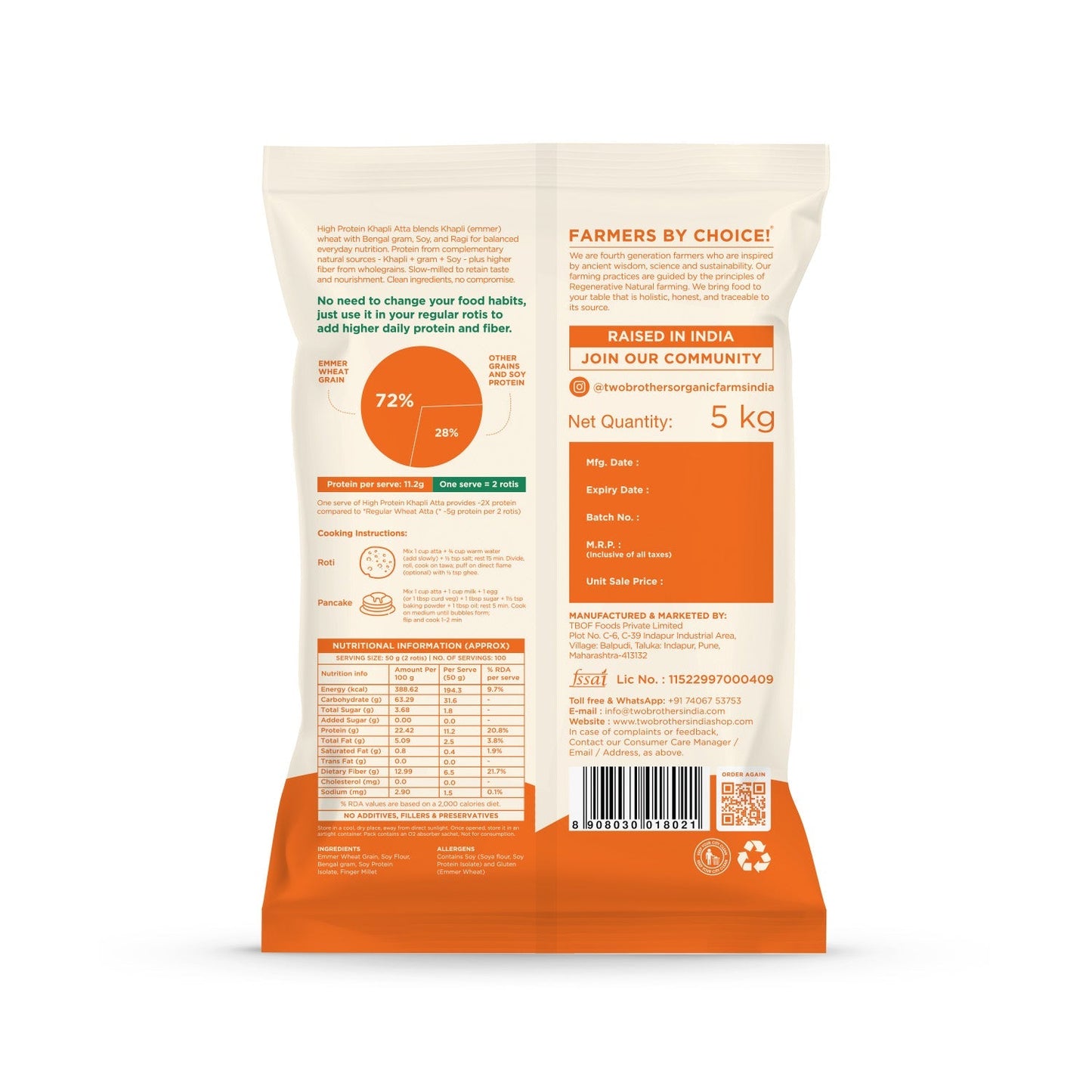
 Nearly three quarters of the flour is Khapli, the emmer wheat Two Brothers is known for, not a hybrid wheat with protein stirred in.
-
 The protein arrives with 13 g of fibre per 100 g, because most of it comes from whole gram, soy and ragi.
-
 We like that the pack names every ingredient and prints a full per-100 g table, when a per-roti headline would have been easier.
-
 Nothing added: no emulsifier, improver, enzyme or preservative.
-
 It cooks like normal atta, so the extra protein costs nothing in effort.


What to look for in Atta?
What to look for in Atta?
- 01Read where the protein comes from. Whole legumes and millets bring fibre and minerals with them; a protein isolate or added gluten brings protein alone.
- 02Check the grain. Khapli (emmer) is an ancient wheat; most protein attas start from hybrid wheat.
- 03Look for a full nutrition table per 100 g, not just a per-roti headline. Serving sizes vary.
- 04An additive-free list should have no emulsifier, enzyme or improver.
- 05Ask about residue testing. Wheat is a heavily sprayed crop and glyphosate is rarely tested for.
What's inside
The slow-milled whole-grain base of the flour, with bran and germ kept in and gluten present.
Ground whole soybean that adds protein and a little fat, and is a declared allergen.
Roasted gram that adds protein, fibre and the nutty note in the roti.
A concentrated protein extracted from defatted soy that does much of the work on the protein number, more processed than anything else in the list.
Adds calcium and fibre and darkens the flour slightly.
Two Brothers High Protein Khapli Atta vs other high-protein attas
| What to compare | Purepicked | Other high-protein attas |
|---|---|---|
| Grain base | 72% Khapli (emmer) wheat, an ancient grain | Usually modern hybrid wheat |
| Where the protein comes from | Bengal gram, soy flour, soy protein isolate and ragi | Often soy or pea protein isolate plus added wheat gluten |
| Protein per 100 g | 22.4 g | Typically 15 to 20 g |
| Fibre per 100 g | 13 g | Often 8 to 11 g |
| Additives | None | May include emulsifiers, enzymes or added gluten |
| Milling | Slow-milled | Roller-milled at speed |
Nutrition facts · per 100 g
- Energy
- 388.62 kcal
- Protein
- 22.42 g
- Carbohydrate
- 63.29 g
- Total sugars
- 3.68 g
- Added sugars
- 0 g
- Dietary fibre
- 12.99 g
- Total fat
- 5.09 g
- Saturated fat
- 0.8 g
- Trans fat
- 0 g
- Cholesterol
- 0 mg
- Salt
- <0.01 g
How to use it
- Knead as you would regular atta, with a touch more water; rest 15 minutes and roll rotis or phulkas
- Make parathas and stuffed parathas; the flour holds together well
- Mix with milk, egg or curd and a pinch of baking powder for high-protein pancakes
- Use for thepla and puri where a nuttier flavour is welcome
- Blend half and half with plain Khapli atta if you want a milder taste
Is it for you?
Good for
Anyone trying to raise daily protein without changing what they cook
Vegetarian households where roti is the main carbohydrate
People who already buy Khapli atta and want more protein and fibre from it
Growing kids and active adults, as part of a normal diet
Avoid if
Anyone with a soy allergy; it contains soy flour and soy protein isolate
Gluten-free or coeliac diets; emmer is wheat
Anyone who wants a single-grain, unblended atta
Anyone who would rather avoid protein isolates altogether
Product details
- Sold by
- Purepicked
- Brand
- Two Brothers India Farms
- Net quantity
- 2 kg, 5 kg
- Type
- Atta & Flours
Also on the label
Questions people ask
What's in this atta?
72% slow-milled Khapli (emmer) wheat, with Bengal gram, soy flour, soy protein isolate and finger millet. No additives, fillers or preservatives.
How much protein does it have?
22.4 g of protein and 13 g of fibre per 100 g. Two rotis carry about 11 g of protein, roughly twice a regular wheat atta.
Is it gluten-free?
No. Khapli is lower in gluten than modern wheat but it is still wheat, so it isn't for gluten-free or coeliac diets. It also contains soy.
Do I need to cook it differently?
No. Knead as usual with a touch more water and rest for 15 minutes. For a milder taste, blend it half and half with plain Khapli atta.
Is the protein all from whole foods?
Not all. Part of it comes from soy protein isolate, a refined ingredient. The rest comes from whole grain, gram, soy flour and ragi.
Still unsure? Ask us on WhatsApp