


Why we picked it
-
 One ingredient, cold-pressed and filtered once, the same oil sold by the litre.
-
 We like that the can uses compressed air behind a sealed bag, not a hydrocarbon propellant mixed into the oil.
-
 No lecithin, anti-foam or emulsifier, which most sprays need to make refined oil behave.
-
 The base oil's lab reports cover the things that matter for groundnut oil: argemone, residual hexane, aflatoxin and heavy metals, all clear.
-
 About 4 kcal a spray, rather than a zero conjured from a tiny serving size.
-
 A light coat on a tawa or air-fryer basket uses a fraction of what a pour does.


What to look for in Oil Spray?
What to look for in Oil Spray?
- 01Read the propellant. Many sprays mix butane, propane or isobutane into the oil itself; a bag-on-valve can uses air that never touches the food.
- 02The ingredient list should be one oil. Lecithin, dimethyl silicone and emulsifiers are there to make a refined oil spray evenly.
- 03Ask how the oil was made. Refined oil is usually solvent-extracted, and that step is never declared on the label.
- 04Be wary of 0 kcal claims. Oil is 9 kcal a gram; a zero comes from a tiny serving size, not from the oil.
- 05Look for contaminant testing. Groundnut oil should be checked for argemone, aflatoxin and residual hexane.
What's inside
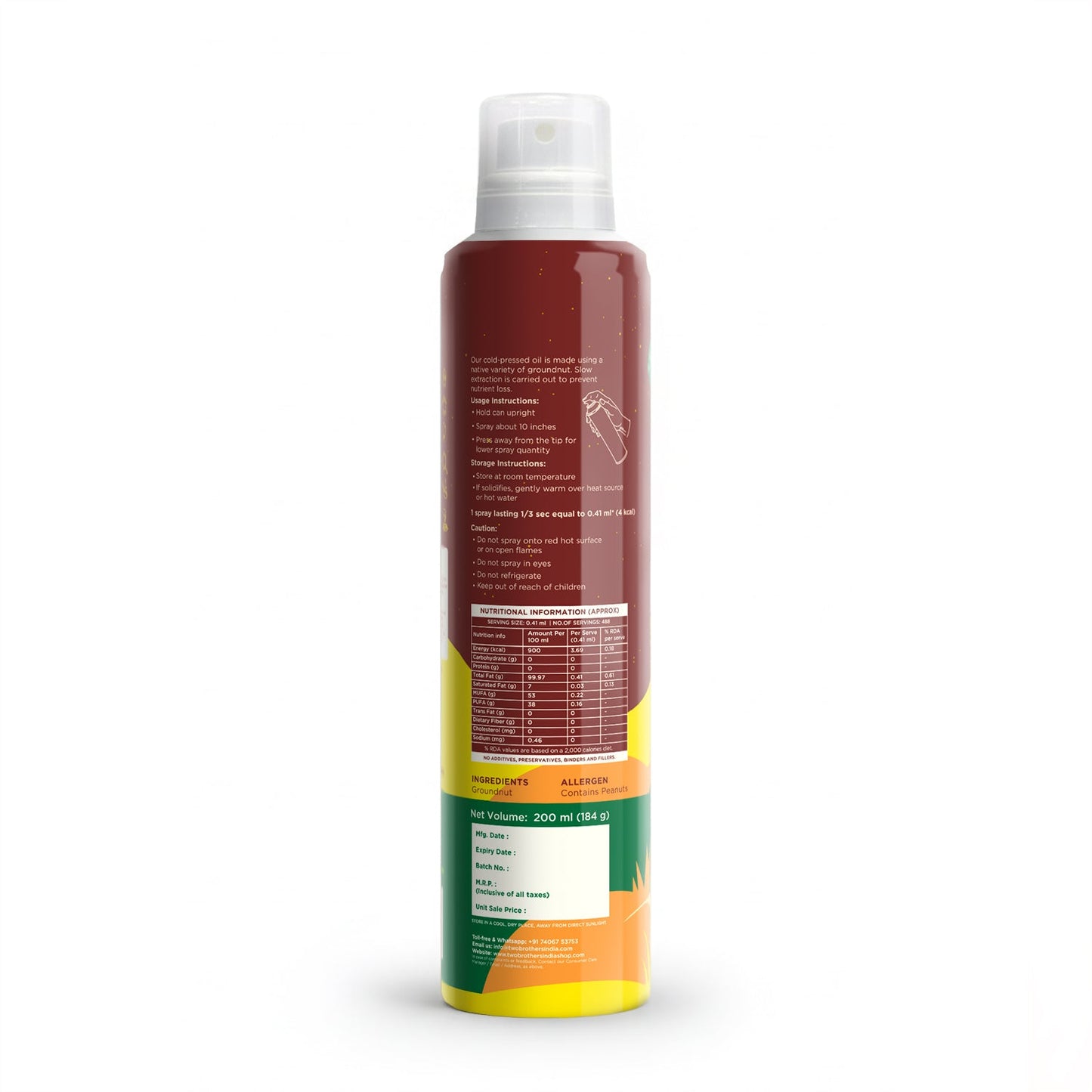
Cold-pressed from a native groundnut variety and filtered once, so it keeps its colour and aroma; contains peanut, an allergen.
Sits outside a sealed inner bag and pushes the oil out without ever mixing with it, so there is no butane, propane or other chemical propellant.
Two Brothers Groundnut Oil Spray vs other cooking oil sprays
| What to compare | Purepicked | Other cooking oil sprays |
|---|---|---|
| The oil | Cold-pressed, single-filtered groundnut oil, one ingredient | Often refined, solvent-extracted oil or a blend |
| Propellant | Compressed air in a bag-on-valve can; never touches the oil | Often butane, propane or isobutane mixed into the oil |
| Additives | None | May include soy lecithin, dimethyl silicone (anti-foam) or emulsifiers |
| Contaminant testing | Argemone, residual hexane, aflatoxin and heavy metals tested, Astute Labs, July 2025 | Rarely tested |
| Per spray | About 0.41 ml and 4 kcal | Often labelled 0 kcal by using a very small serving size |
| Fat profile per 100 ml | 7 g saturated, 53 g MUFA, 38 g PUFA | Depends on the oil; refining does not change it |
Nutrition facts · per 100 g
- Energy
- 900 kcal
- Protein
- 0 g
- Carbohydrate
- 0 g
- Total sugars
- 0 g
- Added sugars
- 0 g
- Dietary fibre
- 0 g
- Total fat
- 99.97 g
- Saturated fat
- 7 g
- Trans fat
- 0 g
- Cholesterol
- 0 mg
- Salt
- <0.01 g
How to use it
- Mist an air-fryer basket or tray before loading, then again lightly halfway through for colour
- Spray a hot tawa or pan before dosa, chilla, eggs or parathas
- Coat vegetables and paneer for roasting or grilling
- Grease cake tins and baking sheets evenly
- Spray over a salad and toss for a light dressing
Is it for you?
Good for
Air-fryer, grill and tawa cooking where a light, even coat is the point
Anyone measuring oil intake who still wants an unrefined oil
Greasing baking tins and salad dressings
Households that already cook with groundnut oil
Avoid if
Anyone with a peanut allergy
Deep frying or any use that needs a pour; buy the bottled oil instead
Anyone who wants a completely neutral, odourless oil; this is unrefined and tastes of groundnut
Spraying onto an open flame or a red-hot pan
Product details
- Sold by
- Purepicked
- Brand
- Two Brothers India Farms
- Net quantity
- 200 ml
- Type
- Cold-Pressed Oils
Also on the label
Questions people ask
What propellant does the can use?
Compressed air, held outside a sealed inner bag, so it never touches the oil. There is no butane, propane or other chemical propellant.
How much oil is in one spray?
A third-of-a-second press lays down about 0.4 ml, or about 4 kcal, of oil.
Who should avoid it?
Anyone with a peanut allergy. It is unrefined and tastes of groundnut, so it isn't for anyone wanting a neutral oil.
Still unsure? Ask us on WhatsApp